Miditin one
Concept
This plugin was motivated by observing how an arpeggio, on a classical piano performance, can sound so fluid and organic. To produce this type of organic flow of notes takes a lot of detailed work, and it's really tricky to get it quite right. Except for professional piano performers, of course. One small note out of place, or one wrong velocity can easily break the illusion. The main concept was the idea of driving the triggering of notes and velocity with curves, particularly a sine wave.
Another wish I had, which led me to create this plugin was the possibility of creating sort of flocks of melodies: a melody, repeated many times at the same time at different rates and at different tonalities; producing an immersive effect. I think it actually occurred to me on a dream. I tried to create some by hand, but since I didn't understand the mechanism too well yet, it would take many iterations to get it (one example). A plugin of this type would allow me to experiment and generate these flocks rapidly, consequently allowing me to create much better variations of this.
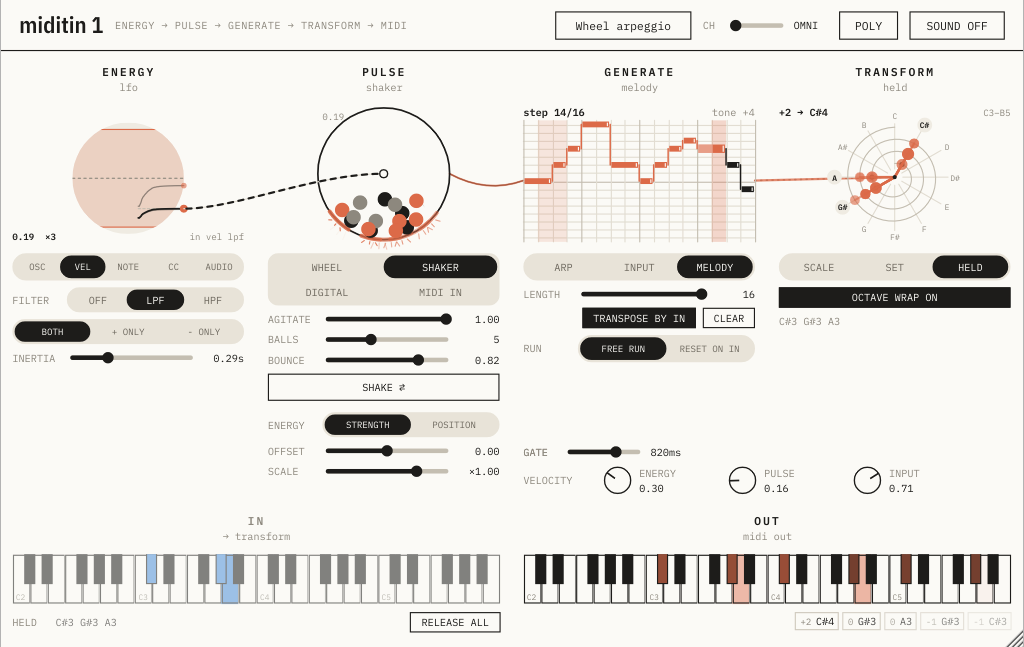
The obvious concept that came to my mind was to separate the generation of notes into three aspects: the energy control (based on waves), a wheel (as in wheel of fortune), and the selection of output notes. It was a bit less obvious that the notes generation had to be separate into two: the generation of grades within a scale or chord, and the generation of the scale or chord itself. This idea came from my experience creating generative composition systems such as polimod or the generative harp. By plugging a natural wave such as a sine wave to the rate at which notes are generated, I expected to get an organically flowing arpeggio.
With the same underlying mechanisms plus a melody-based arpeggiator, I knew I would be able to generate the aforementioned melodic flocks too.
The rest of the features appeared naturally. For example, if we are driving a wheel with a sine wave, then why not also having square and ramp. Why not being able to control the curve directly with CC. Also, since these are physical models and we are trying to produce organic flows, the idea of adding LPF to the energy control signal was an inevitable occurrence. If there is a wheel, perhaps a shaker model is also a good idea. HPF also came to be naturally, as in a shaker movement, one usually hears the onsets of movement more than a continuous thing. The digital and midi pulse generation modes were added so that one could also produce conventional, straight arpeggios.
The generation of the code was quite straightforward, first creating a prototype with Claude design, which got and represented the concept quite well on the first prompt. The feature set was modeled here a bit, and then translated into a plugin using Claude Code with the Juce library.
I was quite satisfied with the result, I especially all the configurations in between my initial wishes of organic flows and melodic flocks, which is why I decided to publish it and share the code.